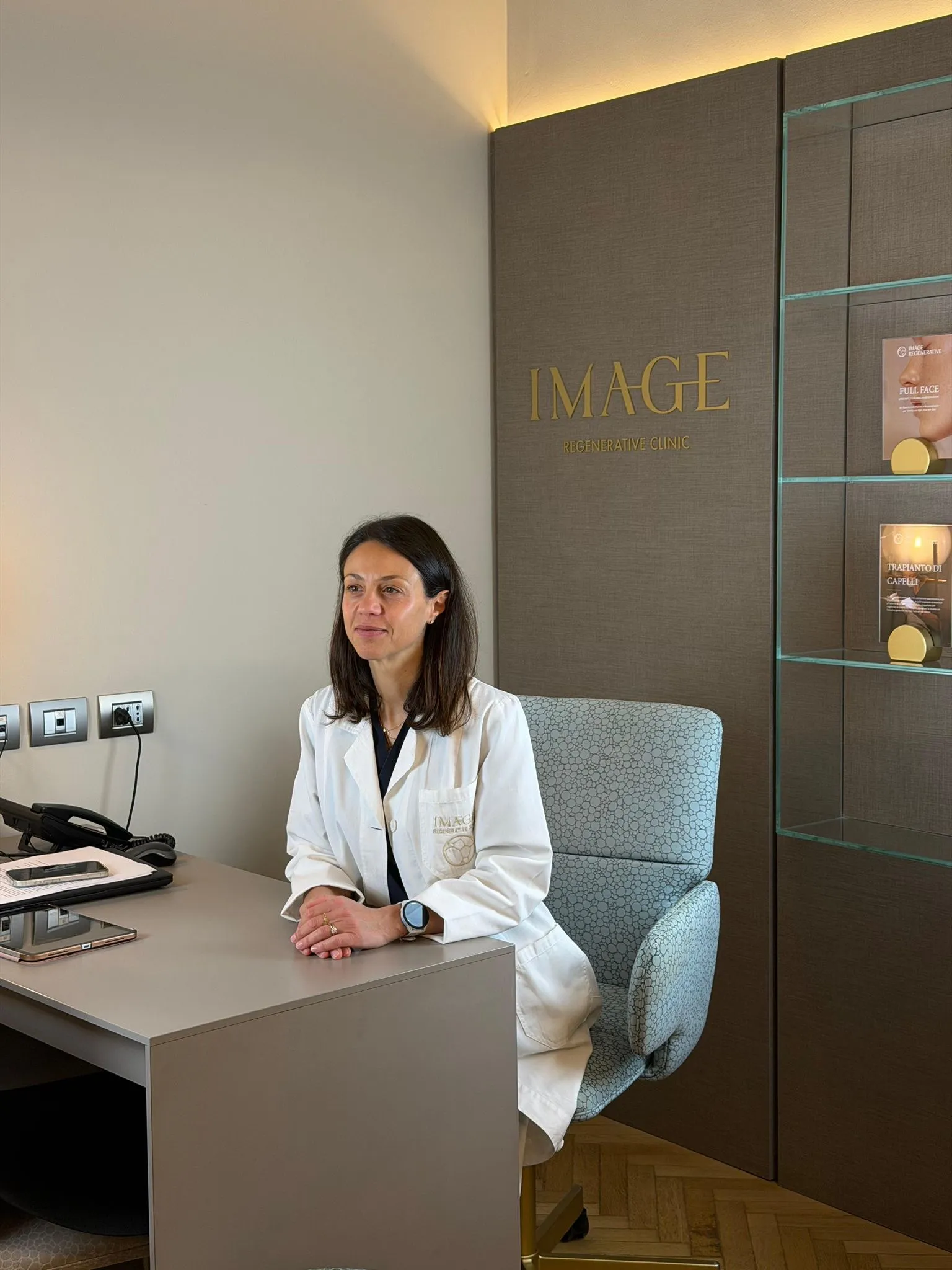

Surgeon · Master's Degree in Aesthetic Medicine · Imperial College London Fellowship
Medicina Estetica Rigenerativa · 10 min read
There’s a question that guides me in every consultation, and it’s different from the one patients expect. Not “what can I correct?”, but “how can I help this skin work better?”. It’s a small shift in words, but an enormous one in substance. It’s the heart of what I call regenerative aesthetic medicine — and it’s the way I’ve chosen to work.
For years, aesthetic medicine had a single logic: where something is missing, you add it. Missing volume? Fill it. A wrinkle? Smooth it out. An effective approach, but one that treats the skin as a surface to correct, not as living tissue to regenerate. Regenerative medicine flips this logic on its head. My principle, if I had to sum it up in a few words, is simple: I don’t fill, I regenerate.
What regenerative aesthetic medicine really is
Regenerative aesthetic medicine isn’t a single treatment: it’s an approach. Rather than simply masking an imperfection, it uses the body’s own biological mechanisms to repair and renew tissue from within. The goal isn’t the result of a single afternoon, but the quality and longevity of the tissue over time.
In practice, this means stimulating the skin to produce its own new collagen and elastin, improving cell vitality, and reactivating repair processes that slow down with age. Fillers, botulinum toxin and lasers remain valuable tools — but they become part of a bigger picture, not the automatic answer to every sign of ageing.
It’s no coincidence that regenerative medicine has become the central theme of aesthetic medicine in 2026: the market and patients are moving away from overfilled “social media faces” towards a more natural kind of beauty, where the goal isn’t to look “done”, but simply to look like a more rested, healthier version of yourself.
The difference with “traditional” aesthetic medicine
The clearest way to understand it is to compare the two approaches:
| Traditional approach (corrective) | Regenerative approach | |
|---|---|---|
| Starting question | What do I correct? | How do I help the skin regenerate? |
| Strategy | Add/fill from the outside | Stimulate production from within |
| Result | Immediate, but static | Progressive, natural, evolving |
| The filler is… | The main answer | One tool among many, used precisely |
| Goal | Correct the imperfection | Improve tissue quality and longevity |
This doesn’t mean demonising fillers: used with restraint, in the right spot, they’re irreplaceable. It means no longer using them as the only solution. I’ve written a dedicated guide on how to navigate the different treatments — from skincare to surgery — in the scale of skin treatments: it’s the practical companion to this article.
The tools of regeneration
The regenerative approach relies on a precise “toolkit”. Here are the main ones, from the most established to the most innovative.
Biorevitalisation and skinboosters. Biorevitalisation micro-infiltrates the dermis with non-cross-linked hyaluronic acid, vitamins and antioxidants to hydrate the skin deeply and reactivate its functions. It’s often the first, genuine regenerative gesture, at any age.
Collagen biostimulators. Molecules like poly-L-lactic acid and calcium hydroxyapatite don’t fill: they push the skin to produce new collagen, with a gradual improvement in firmness and support. The result appears over weeks, which is exactly why it looks so natural.
Autologous factors (from your own body). PRP (platelet-rich plasma) and nanofat are the purest expression of regeneration: the patient’s own growth factors and cells are used to repair tissue. No foreign substance, maximum biocompatibility.
Polynucleotides and exosomes. These are the protagonists of the most recent trends: the former support tissue repair, the latter carry regenerative signals between cells. Very promising, but — in all honesty — still the subject of study and regulatory definition. I offer them with caution, evaluating case by case, never as a miracle promise.
Regenerative surgery. When needed, even the scalpel can be regenerative: in conservative blepharoplasty or in liposuction with lipofilling, tissue is preserved and redistributed rather than simply removed.
The principle of naturalness (and avoiding excess)
There’s a thread that ties all these tools together: the idea that the best aesthetic result is the one you don’t notice. Regenerative medicine doesn’t aim to transform a face, but to help it age well — with more radiance, tone and freshness, while remaining recognisably you.
It’s the exact opposite of the “more is better” logic. When every sign of sagging is chased with filler, you end up with those unnatural, puffy faces we all recognise. Skill isn’t about doing a lot, it’s about the right gesture, in the right measure — and sometimes about doing nothing, and waiting.
Why a surgeon practises it differently
This is the most personal part of the story. My training didn’t begin in aesthetics: it began in general surgery, between the operating theatre, emergencies and thousands of procedures in complex settings, with an international Fellowship in London. I came to aesthetic medicine afterwards, bringing with me a surgeon’s eye.
What does that actually change? It means I know tissue at every level — from the surface of the skin down to the deepest planes — and that I have the entire scale of intervention available, from skincare to the operating theatre. A doctor who only has injectable tools will, understandably, tend to suggest an injectable even when the problem is of a different nature. Being able to assess the full spectrum means being able to tell you truly what’s needed — and having the honesty to tell you when a treatment isn’t the right solution.
It’s this combination — a surgeon’s precision and a regenerative philosophy — that allows me to build personalised, measured, consistent journeys over time, instead of chasing a single imperfection.
Regenerating isn’t just about skin
There’s one last aspect worth mentioning. Regenerative logic isn’t just about the face: it’s about the whole body. Skin quality reflects metabolic health, inflammation, lifestyle. That’s why true regenerative medicine looks at the person — their balance and longevity — not a single isolated flaw. The face is often the starting point of a much bigger conversation about wellbeing.
Who it’s for
Regenerative aesthetic medicine is for those who:
- want to prevent and slow down signs of ageing, not just mask them
- are looking for natural results that respect their own identity
- prefer a journey built over time rather than a single, isolated procedure
- want a doctor who assesses the whole picture, with the freedom to choose the right tool — even when that’s “no treatment, for now”
There’s no single right age for everyone: what matters is the real condition of the skin and tissue. But the underlying logic is always the same — starting early with gentle stimuli is more effective, and more elegant, than intervening late with major corrections.
If this way of thinking about beauty resonates with you, I’d be glad to assess the right path for you together: a bespoke plan that starts not from what can be corrected, but from what your skin genuinely needs to look — and be — at its best.
Related Treatment
Skin Biorevitalisation Milan — Profhilo and Hyaluronic Acid with Dr. Alice Miegge
Skin biorevitalisation is an injectable treatment that delivers non-cross-linked hyaluronic acid, vitamins and amino acids directly into the dermis to restore deep skin hydration and stimulate the skin's natural production of collagen and elastin. The full course involves 2–3 sessions spaced 3–4 weeks apart, with results visible from the first session.
Who wrote this article
Dr. Alice Miegge
Surgeon specialised in General Surgery, with a Master's Degree in Aesthetic Medicine and Laser Therapy (University of Pavia). Fellowship at Imperial College NHS Trust, London. Author of 15+ international scientific publications.