
Surgeon · Master's Degree in Aesthetic Medicine · Imperial College London Fellowship
Medicina Estetica Rigenerativa · 10 min read
“I read that it dissolves fat without you having to do anything.” That’s how most people open the conversation about cryolipolysis, and it’s the right place to start — because it contains two misconceptions that, left uncorrected, almost always lead to disappointment.
Cryolipolysis does work: it’s one of the few non-surgical treatments for localised fat with solid literature behind it. But it works for one specific thing, on a specific type of patient, with a result that has a quantifiable limit. This article is here to help you work out whether you fall into that category — and to recognise when it’s being proposed to you inappropriately.
What the cold actually does
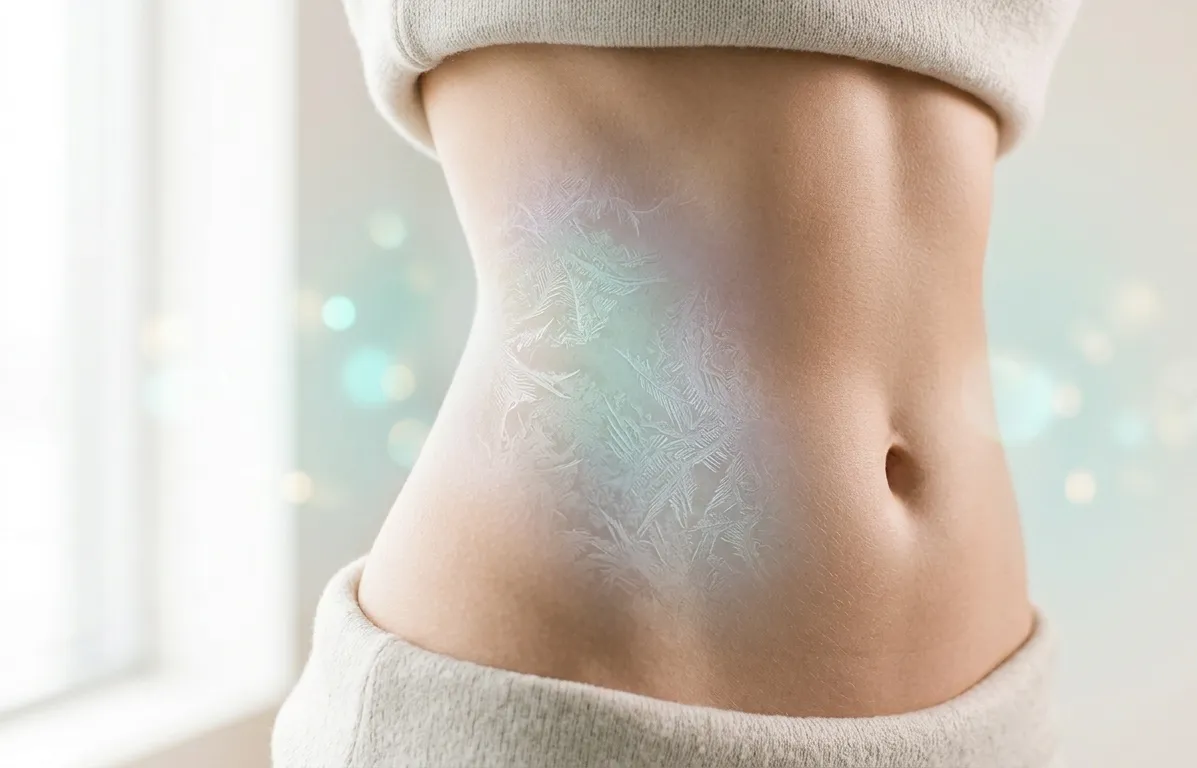
Fat cells are more sensitive to cold than other tissues. By cooling the area to a controlled temperature, selective damage is induced in the adipocytes, while skin, blood vessels and nerves tolerate that temperature without consequence.
The part that’s almost always missed is what happens next: the damaged cells aren’t removed, they’re eliminated by the body over 8-12 weeks through normal metabolic processes. There’s no suction, no mechanical removal. I’ve described the mechanism in detail on the dedicated cryolipolysis page.
This is why the result isn’t visible straight away, and why anyone looking for an immediate effect is looking for the wrong thing.
The pinch test
There’s a simple way to get an idea before even coming in: try pinching the area that bothers you.
If you can grasp a fold between thumb and forefinger, that fat is subcutaneous — exactly the tissue the applicator can act on, because it’s drawn into the device by suction.
If instead the area is firm, taut, and won’t be pinched, you’re most likely touching visceral fat: the deep fat located between the organs. It’s the most relevant for metabolic health, but no aesthetic treatment can reach it — and the correct answer there is a nutritional programme, not a session.
The ideal candidate, in short:
- Stable weight, close to their target weight
- A limited, pinchable fat deposit that resists diet and exercise
- Skin with good elasticity
- Realistic expectations about improved contour, not weight loss
Who will get little from it:
- Anyone needing to lose several kilos — cryolipolysis isn’t a weight-loss treatment
- Anyone with substantial, widespread fat deposits
- Anyone wanting a result for an occasion three weeks away
The numbers, honestly
The documented reduction is around 20-25% of the fat thickness in the treated area, per single session.
It’s a figure worth reading in two opposite ways, because both are true:
It’s little if you expect the fat to disappear. A fifth of a substantial fold is barely noticeable, which is why those with a lot of fat end up disappointed.
It’s a lot if your issue is a thin but stubborn fold — the one that has resisted for years despite your being at your target weight. There, a fifth less visibly changes the contour.
It’s the same quantity, worth a great deal or very little depending on the starting point — which is why the assessment matters more than the treatment.
Why it takes three months (and why that’s a good thing)
The elimination of damaged cells is gradual: the first changes appear after 4-6 weeks, the final result at around three months.
This slowness has an advantage nobody mentions: the change is progressive, so there’s no visible “before and after”. People around you see an improved contour without being able to identify a procedure — which is exactly what most people want.
It does have a practical consequence, though: standardised photos before starting aren’t a bureaucratic detail. When change is gradual, visual memory isn’t reliable: without a photographic comparison, three months later you won’t be able to say with certainty what has changed.
Cryolipolysis and the other non-surgical options
| Cryolipolysis | Cavitation | Radiofrequency | Lipolytic injections | |
|---|---|---|---|---|
| Mechanism | Controlled cooling | Ultrasound | Heat | Injected substances |
| Target | Pinchable fat | Superficial fat | Laxity + fat | Small deposits |
| Sessions | 1-3 per area | 6-10 | 6-8 | 2-4 |
| Result | Progressive, 3 months | Gradual | Gradual | Variable |
| Evidence | The strongest of the group | More limited | Good on laxity | Mixed |
None of these, it must be said, competes with regenerative liposuction, which acts in a single session on far greater volumes. They’re tools for different needs: those with limited fat who don’t want surgery, versus those seeking a significant change in body contour.
How to spot a poor proposal
This is the part that interests me most, because it’s where people come to harm — financially, and sometimes in their skin.
The package decided before any result. If six sessions are sold to you in one block before the effect of the first has even been seen, the decision is being made blind: the result of a session is assessed at 8-12 weeks, not sooner.
The promise of weight loss. Anyone telling you you’ll lose weight with cryolipolysis is describing a different treatment from the one you’ll receive.
No questions about your health. There are serious, specific contraindications to cold — cryoglobulinaemia, cold agglutinin disease, paroxysmal cold haemoglobinuria — and these are medical conditions, not details. If nobody asks you about them, nobody has ruled them out.
Silence about paradoxical adipose hyperplasia. This is a rare but documented adverse effect in which the treated area increases in volume instead of reducing. It isn’t a reason to decline, it’s a reason to know beforehand: a professional who doesn’t mention it either doesn’t know about it, or has chosen not to tell you.
No initial photographs. Without a photographic comparison the result can’t be demonstrated — and it’s worth asking who benefits from that ambiguity.
What cryolipolysis doesn’t do
- It doesn’t cause weight loss. It acts on shape, not on weight.
- It doesn’t treat visceral fat, the deep fat between the organs.
- It doesn’t treat cellulite: that’s a problem of connective tissue structure, not of fat quantity.
- It doesn’t tighten skin. Where there’s laxity, reducing the volume beneath can even accentuate it: that calls for a different assessment.
- It doesn’t replace a lifestyle. The remaining cells can always increase in volume.
In conclusion
Cryolipolysis is a good treatment for a specific problem: a localised, pinchable fat deposit, in someone close to their target weight, willing to wait three months for a partial but real improvement.
Outside that description, the odds of disappointment are high — not through any fault of the technology, but because it was offered to someone who needed something else.
If you recognise yourself in that description, or want to find out whether you fit it, in a consultation we assess the fold, the skin quality and your proportions together: from there it takes minutes to establish whether it makes sense — and sometimes the honest answer is that another route would serve you better.
Related Treatment
Cryolipolysis Milan — Localised Fat Reduction with Dr. Alice Miegge
Cryolipolysis reduces localised fat by cooling adipose tissue in a controlled way to a temperature that selectively damages fat cells, without affecting skin, blood vessels or nerves. It's a non-surgical treatment with no needles and no downtime: the damaged cells are gradually eliminated by the body over the following 8–12 weeks.

Who wrote this article
Dr. Alice Miegge
Surgeon specialised in General Surgery, with a Master's Degree in Aesthetic Medicine and Laser Therapy (University of Pavia). Fellowship at Imperial College NHS Trust, London. Author of 15+ international scientific publications.