
Surgeon · Master's Degree in Aesthetic Medicine · Imperial College London Fellowship
Chirurgia Estetica Rigenerativa · 14 min read
Regenerative liposuction is today one of the most sought-after body surgery procedures in Italy — not because it promises miracles, but because it offers something diet and exercise can’t: the permanent removal of localised fat cells in specific areas, with the option of reinjecting that fat where it’s needed. This guide covers everything you need to know before booking a consultation.
What is regenerative liposuction and how does it differ from the traditional procedure?
Traditional liposuction removes excess fat and discards it. Regenerative liposuction takes it a step further: the aspirated fat is processed and enriched with the stromal vascular fraction (SVF), rich in adipose stem cells and growth factors, and reinjected into areas that need volume — buttocks, hips or areas of asymmetry.
The result isn’t just subtraction, but an intelligent redistribution of adipose tissue. You take away where there’s too much, and add where it’s needed. This approach — known as autologous lipofilling — achieves graft survival rates of up to 70-80% with an optimal technique, compared to 40-50% for traditional liposuction with simple re-implantation.
Who is the ideal candidate for regenerative liposuction?
The first thing to understand is that liposuction isn’t a weight-loss treatment. It’s not for losing weight: it’s for redesigning body proportions in someone who’s already close to their target weight but has localised fat resistant to physical activity.
The ideal candidate has:
- Stable body weight for at least 3-6 months, ideally within 20% of their target weight
- Localised fat in specific areas (abdomen, hips, thighs, arms) unresponsive to exercise
- Good skin elasticity, which ensures optimal skin retraction after fat removal
- Realistic expectations: the goal is to improve proportions, not radically change the silhouette
- Good general health, with no conditions that would contraindicate anaesthesia
The main contraindications include: severe obesity (BMI > 30), significant skin laxity (in these cases, a combined abdominoplasty is considered), uncontrolled diabetes, coagulopathies and significant cardiovascular disease.
Which areas can be treated with regenerative liposuction?
Areas treatable with liposuction include practically anywhere on the body where localised fat accumulates:
Trunk and abdomen: upper and lower abdomen, hips, waist, lower back. HD liposculpture can define the abdominal muscles by selectively removing superficial fat above the muscle fascia.
Lower limbs: inner and outer thighs (including so-called saddlebags), knees, ankles. These areas require particular attention to skin quality to avoid irregularities.
Upper limbs: the triceps area of the arms, underarms. Arm skin requires excellent elasticity for adequate retraction.
Male chest area: gynecomastia — excess fatty (and sometimes glandular) tissue in the male chest — responds very well to liposuction, which can effectively treat even the more fibrous glandular tissue.
Donor area for lipofilling: the areas from which fat is harvested for re-implantation are usually the abdomen, hips and thighs — areas with abundant, good-quality fat tissue for grafting.
How does the procedure work, step by step?
1. Surgical consultation and body mapping
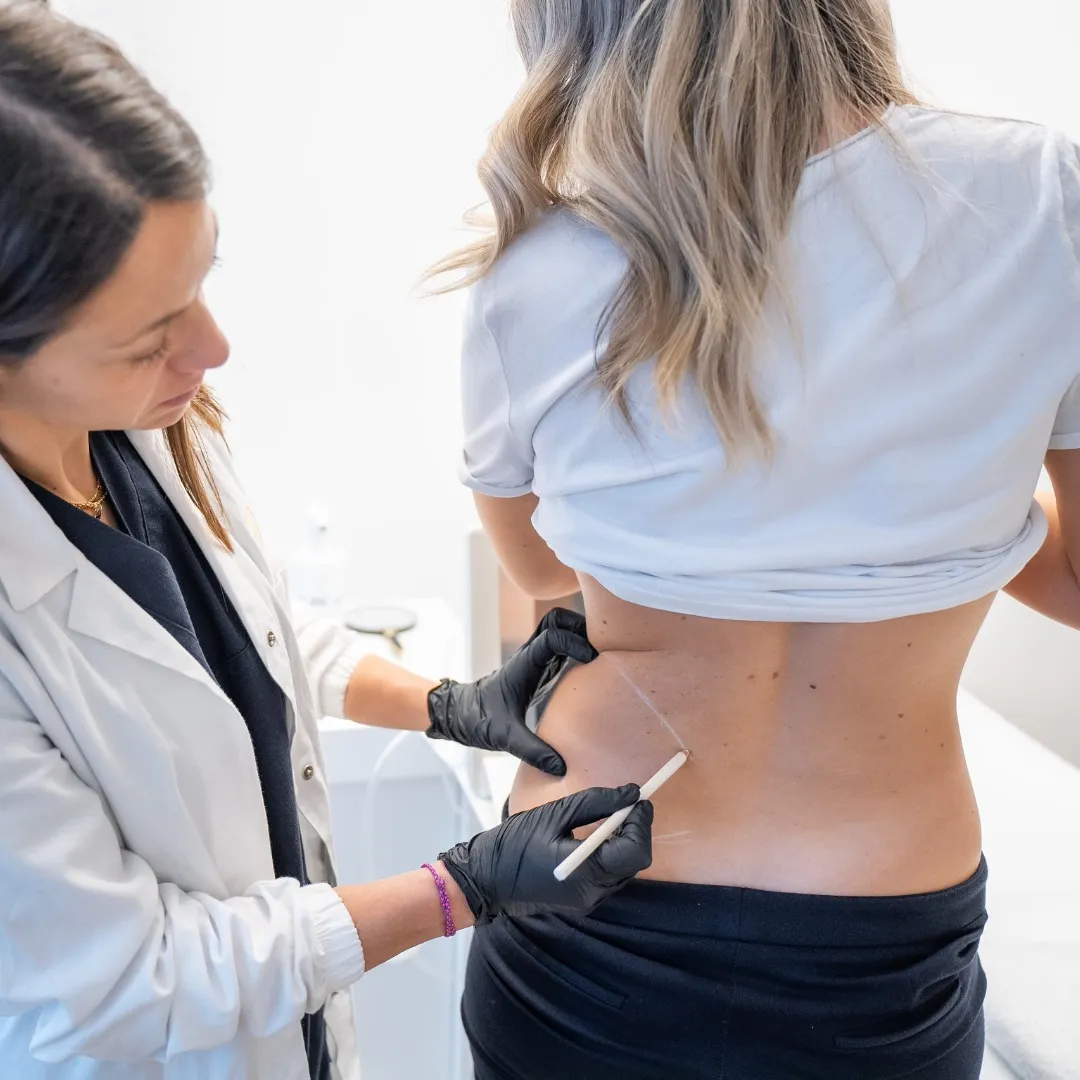
The consultation is the most important step. Dr. Miegge assesses fat distribution, skin quality, muscle tone and body proportions in a standing position. Donor areas and any recipient areas for lipofilling are identified, and the patient’s expectations are discussed in depth.
2. Pre-operative tests
Standard blood tests and an anaesthesiology consultation are prescribed. In the 10 days before surgery, anticoagulant medication (aspirin, ibuprofen) and omega-3 and vitamin E supplements are stopped.
3. Tumescent solution infiltration
Before liposuction, a solution of local anaesthetic (lidocaine), adrenaline and saline is infiltrated into the areas to be treated. The tumescent solution reduces bleeding by up to 80%, facilitates fat breakdown and keeps local anaesthesia active for hours after the procedure.
4. Emulsification
An ultrasound probe is inserted through 3-4mm micro-incisions and moved through the areas being treated, selectively emulsifying fat cells without damaging surrounding tissue. This stage lasts from 20 to 60 minutes depending on the areas treated.
5. Aspiration with small-diameter cannulas
The emulsified fat is aspirated using 2.5-4mm diameter cannulas. The access micro-incisions, placed in anatomically hidden areas (navel, groin creases, inframammary fold), leave no visible scarring.
6. Fat processing and lipofilling (if indicated)
The aspirated fat is centrifuged at low speed (around 1200 rpm) using a modified Coleman technique to preserve cell viability. The purified adipose concentrate is then reinjected via micro-injections into the recipient areas.
7. Compression garment
At the end of the procedure, an elastic compression garment is applied, to be worn continuously for the first 4 weeks, then only during the day for a further 2-4 weeks. The garment reduces oedema, supports the skin during retraction and optimises the final result.
How long is the recovery after regenerative liposuction?
Recovery is progressive and depends on the extent of the procedure (number of areas treated, amount of fat removed) and individual response.
First 3-5 days: swelling, bruising and bruised-looking skin in the treated areas, manageable with common painkillers (paracetamol). Possible soreness and tension. This is normal and expected.
Days 7-10: most patients resume sedentary activities and office work. Swelling visibly decreases but is still present.
Weeks 3-4: light physical activity resumes (walking, cycling). The daytime compression garment is removed.
Month 3: 70-80% of the final result is visible. Residual swelling has almost completely resolved.
Month 6: final result. The fat reinjected through lipofilling has completed the process of engraftment and integration into the tissue.
Manual lymphatic drainage sessions are recommended — at least 6-8 sessions in the first 4 weeks — to speed up the reabsorption of oedema and improve the quality of the final result.
How long do liposuction results last?
Liposuction results are permanent as far as the removed fat cells are concerned: once aspirated, they don’t come back. However, remaining fat cells in both treated and untreated areas can expand if there’s significant weight gain after the procedure.
To maintain results over time:
- Keep body weight stable, within 3-5 kg of your weight at the time of the procedure
- Follow a balanced diet
- Exercise regularly (at least 150 minutes of moderate activity per week)
Fat reinjected through lipofilling has a final survival rate of 60-80%: some is naturally reabsorbed in the weeks following the procedure, and the portion that engrafts remains permanently.
What are the risks and complications of regenerative liposuction?
Like any surgical procedure, liposuction carries risks that are discussed in detail during the pre-operative consultation. The main complications are:
Minor, temporary complications (common, resolve on their own): extensive bruising in the treated areas (2-4 weeks), asymmetric swelling in the first few weeks, areas of hypersensitivity or temporary numbness, mild skin irregularities in the early stages of recovery.
Minor, treatable complications: seromas (fluid collections in the treated areas, treated with outpatient aspiration), small profile irregularities that resolve with massage or minor corrections.
Rare but serious complications: infection (reduced risk with perioperative antibiotic prophylaxis), deep vein thrombosis (prevented with low molecular weight heparin and early mobilisation), reaction to anaesthesia.
Risks are significantly reduced by choosing a surgeon with specific training in liposuction, working in accredited facilities with an anaesthesiologist present.
Regenerative liposuction vs other non-surgical treatments: what’s the difference?
There are non-surgical treatments for reducing localised fat — cryolipolysis, ultrasonic cavitation, radiofrequency, lipolytic injections — which are often presented as alternatives to liposuction. Here are the key differences:
| Regenerative liposuction | Cryolipolysis | |
|---|---|---|
| Fat reduction | 60-80% in one session | 20-25% per session |
| Permanence of results | Definitive | Definitive for the treated cells |
| Treatment of fibrous areas | Yes | No |
| Associated lipofilling | Yes | No |
| Downtime required | 7-10 days | None |
| Number of sessions | 1 | 1-3 per area |
Non-surgical treatments have their place for mild localised fat in patients who don’t want or can’t undergo a procedure. For moderate to significant localised fat, or when a substantial, definitive result is desired, liposuction remains the gold-standard treatment.
I’ve written a separate article on when cryolipolysis makes sense, comparing the different non-surgical options and setting out the criteria for knowing whether you’re a candidate.
How much does regenerative liposuction cost in Milan?
The cost depends on the number of areas treated, the amount of fat to be removed and any associated lipofilling.
The cost generally includes the pre-operative consultation, pre-operative tests, anaesthesia, the procedure itself, the compression garment and post-operative check-ups. Before proceeding, it’s important to request a detailed quote specifying exactly what’s included.
Liposuction is an elective procedure.
Regenerative liposuction is a significant procedure that calls for an informed, considered decision. A pre-operative consultation with Dr. Alice Miegge is the first step to understanding whether this procedure suits your specific situation, and what realistic results to expect.
Related Treatment
Regenerative Liposuction Milan — Liposculpture with Dr. Alice Miegge
Regenerative liposuction combines the removal of localised fat with autologous lipofilling in areas that need volume. The fat removed isn't discarded but processed and reinjected where it's needed, achieving harmonious body redefinition with permanent results in a single session.
Who wrote this article
Dr. Alice Miegge
Surgeon specialised in General Surgery, with a Master's Degree in Aesthetic Medicine and Laser Therapy (University of Pavia). Fellowship at Imperial College NHS Trust, London. Author of 15+ international scientific publications.