
Surgeon · Master's Degree in Aesthetic Medicine · Imperial College London Fellowship
Laser Terapia · 10 min read
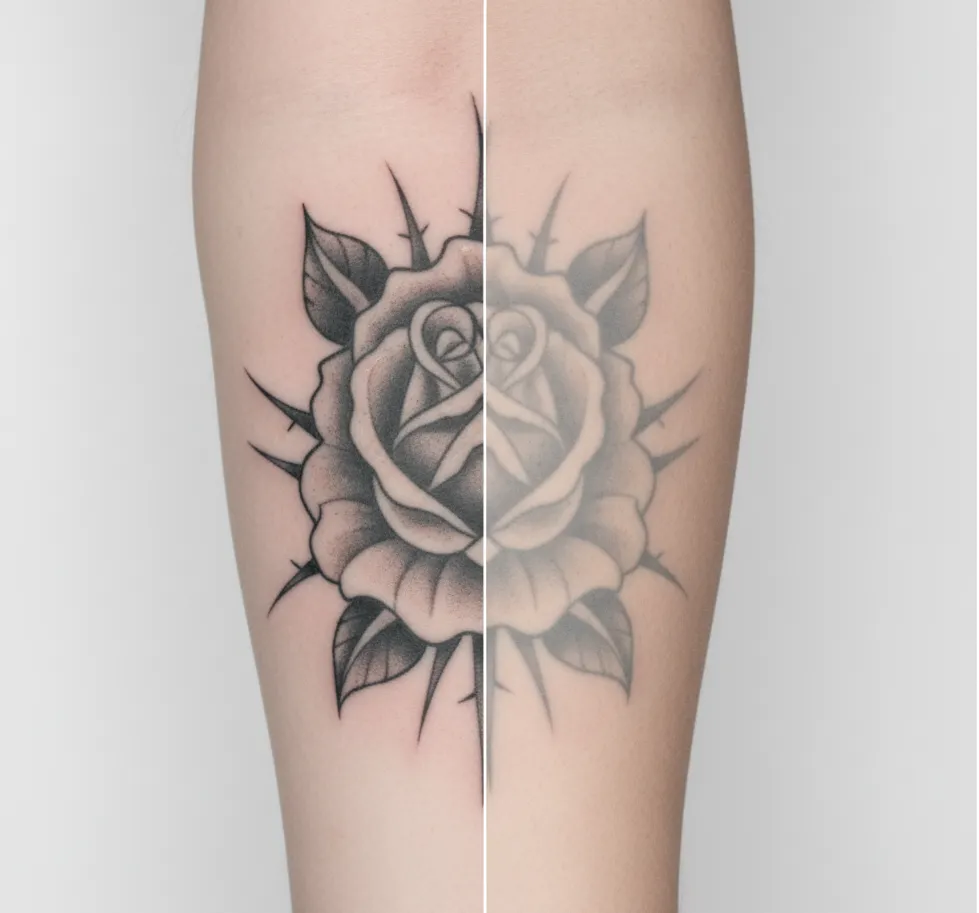
Tattoos tell stories, but sometimes those stories belong to a chapter of life we’d rather close. Whether it’s a youthful mistake, an ex-partner’s name, a poorly executed design or simply a change in taste, tattoo removal has become one of the most frequent requests in aesthetic medicine. Thanks to the latest generation of lasers, even the most complex tattoos can now be permanently erased.
What are picosecond lasers and why are they superior?
Until a few years ago, tattoo removal was a long, painful process that often gave unsatisfying results. Picosecond lasers have completely transformed this field, drastically reducing treatment times and improving effectiveness across all colours.
The main difference between traditional Q-Switched lasers and picosecond systems lies in pulse duration: the former emit pulses measured in nanoseconds (10⁻⁹ seconds), while picosecond lasers work with pulses 100 times shorter (10⁻¹² seconds). This extreme speed generates a superior photo-acoustic effect that shatters pigments into ultra-fine particles, making them easier for the body to eliminate.
| Feature | Q-Switched | Picosecond |
|---|---|---|
| Pulse duration | Nanoseconds | Picoseconds (100x faster) |
| Number of sessions | 8-15 sessions | 4-8 sessions |
| Treatable colours | Limited | All colours |
| Risk of scarring | Higher | Minimal |
| Pain | Significant | Reduced |
How does laser tattoo removal work?
The principle behind laser removal is called selective photothermolysis. Tattoo pigments absorb specific wavelengths of laser light, heating instantly and fragmenting into microscopic particles that are then eliminated naturally by the lymphatic system.
1. Light absorption: the laser emits pulses of light at a specific wavelength, selectively absorbed by the tattoo pigments while leaving surrounding tissue intact.
2. Fragmentation: the laser energy instantly shatters the pigments into nanometre-sized particles through an extremely powerful photo-acoustic shockwave.
3. Natural elimination: the immune system’s macrophages engulf the shattered particles and carry them through the lymphatic system for natural elimination.
How many sessions are needed for a coloured tattoo?
Different colours absorb different wavelengths of light. This is why I use multi-wavelength laser systems, which allow every pigment present in the tattoo to be treated effectively.
- 1064 nm (Nd:YAG): black, dark blue, brown — deep penetration
- 532 nm (KTP): red, orange, yellow — superficial penetration
- 694 nm (Ruby): green, light blue — medium penetration
- 755 nm (Alexandrite): dark green, black — medium-deep penetration
- 1320 nm (Nd:YAG): resistant pigments — very deep penetration
- 595 nm (Dye Laser): bright red — superficial penetration
What affects the outcome of laser removal?
Characteristics of the tattoo:
Age of the tattoo: older tattoos (over 2 years) are easier to remove because the pigments have already partly fragmented naturally.
Size and density: larger, denser tattoos require more sessions. Areas with overlapping colour are particularly challenging.
Colours used: black and red are removed easily. Green, yellow and blue require specific wavelengths. White and pastel shades are the most resistant.
Quality of the work: professional tattoos penetrate more deeply and evenly. Amateur ones can, paradoxically, be harder to treat.
Patient factors:
Skin phototype: fair skin (phototypes I-III) responds better, with a lower risk of post-treatment hyperpigmentation.
Anatomical location: well-vascularised areas (torso, neck) heal better. Distal extremities (ankles, fingers) are slower.
Immune system: an efficient immune system speeds up pigment elimination. Smoking and stress can slow the process.
How does a tattoo removal treatment work?
- Initial consultation: full assessment of the tattoo with photographic documentation, colour analysis, an estimate of the sessions required and a discussion of realistic expectations.
- Patch test: a preliminary test on a small area to assess the skin’s response and optimise the laser parameters for subsequent sessions.
- Preparation: shaving the area, cleansing with antiseptic, applying conductive gel and eye protection for both patient and operator.
- Laser treatment: systematic application of the laser with 10-20% overlap between spots. Continuous cooling of the skin to minimise discomfort.
- Aftercare: application of soothing cream, protective dressing and detailed instructions for home care in the following days.
What happens afterwards:
- Immediately: whitening effect (temporary blanching), redness and swelling
- 24-48 hours: possible formation of superficial scabs — do not scratch
- 1 week: natural peeling; apply moisturiser and SPF 50+
- 4-6 weeks: complete healing, assessment and scheduling of the next session
How much does it cost and how long does removal take?
Cost factors:
- Size: cost is proportional to the area treated
- Complexity: multicoloured costs more than black
- Number of sessions: packages are often better value
- Technology: picosecond costs more than Q-Switched
Typical timescales:
- Simple black tattoo: 4-6 sessions
- Coloured tattoo: 6-10 sessions
- Cover-up or reworked pieces: 8-12 sessions
- Interval between sessions: 6-8 weeks
- Total duration: 8-18 months on average
Important: 100% removal can’t always be guaranteed. Results of 85-95% are considered excellent. Patience is essential: the best results appear months later.
Can fluorescent tattoos and permanent make-up be removed?
Permanent make-up (PMU): tattooed eyebrows, eyeliner and lip contours require specific approaches. PMU pigments often contain iron oxides that can temporarily darken before lightening. A patch test is mandatory, with reduced fluences and longer intervals between sessions (8-10 weeks).
Cover-ups and overlapping tattoos: tattoos covering others create complex layers of pigment. Removal must proceed layer by layer, removing the superficial pigments first, with assessment every 2-3 sessions.
Fluorescent/UV tattoos: modern fluorescent pigments can contain compounds that don’t respond to traditional laser wavelengths. Some may even change colour when exposed to the laser. A patch test is essential.
Who can’t have laser tattoo removal?
Absolute contraindications:
- Pregnancy and breastfeeding
- Tendency to form keloids
- Active autoimmune disease
- Immunosuppressive therapy
- Active infection in the area
- History of melanoma in the area
- Pathological photosensitivity
Special precautions:
- Darker phototypes (V-VI)
- Uncontrolled diabetes
- Coagulation disorders
- Anticoagulant therapy
- Recent tanning
- Recurrent herpes in the area
Are there alternatives to laser tattoo removal?
In some cases, laser removal can be combined with other techniques to optimise results:
Laser + dermabrasion: for particularly resistant tattoos, controlled dermabrasion can be used as a final treatment to eliminate superficial residue.
Laser + TCA peel: deep chemical peels can help remove residual superficial pigment, especially in permanent make-up.
Laser + needling: microneedling can improve laser penetration and speed up the elimination of fragmented pigment.
Why choose Dr. Miegge for tattoo removal?
Over the years I’ve treated hundreds of tattoos of every kind: from small youthful symbols to large artistic pieces, from permanent make-up to complex cover-ups. My approach is built on honesty and transparency: during the initial consultation I always give a realistic assessment of the results achievable, the time required and the overall cost.
My method rests on: careful assessment with photographic documentation, personalised protocols with parameters adapted to each case, advanced multi-wavelength picosecond laser technology, and ongoing support with continuous monitoring and adjustment of the treatment.
Is laser removal permanent? What to expect
Laser tattoo removal is today an effective, safe solution for anyone wanting to erase the past and begin a new chapter. Current technologies, picosecond lasers in particular, have transformed this field and made possible what was unthinkable only a few years ago.
That said, it’s essential to rely on experienced professionals who use certified equipment and follow rigorous clinical protocols. If you’re considering removing a tattoo, remember that every case is different. During the consultation we can assess your specific needs together and create a personalised treatment plan to give you the best possible results in complete safety.
Related Treatment
Laser Tattoo Removal Milan — Q-Switched and Picosecond with Dr. Alice Miegge
Laser tattoo removal uses high-energy light pulses to break down tattoo pigment into microscopic particles, naturally eliminated by the immune system. The number of sessions ranges from 4 to 8 depending on colours, size and depth of the tattoo, with permanent results and intact skin at the end of the course.

Who wrote this article
Dr. Alice Miegge
Surgeon specialised in General Surgery, with a Master's Degree in Aesthetic Medicine and Laser Therapy (University of Pavia). Fellowship at Imperial College NHS Trust, London. Author of 15+ international scientific publications.