
Surgeon · Master's Degree in Aesthetic Medicine · Imperial College London Fellowship
Chirurgia Estetica Rigenerativa· 10 min read
“I’ve tried every diet there is. I’ve lost weight everywhere except my legs.” It’s a sentence I hear often, almost always said in the same tone: that of someone who has been told for years that she just needed to try harder.
When lipoedema is behind that sentence, effort was never the problem. Lipoedema is a disorder of fat tissue, not the result of bad habits. And the first step in dealing with it isn’t a treatment: it’s giving it a name.
Why the name comes before the treatment
Lipoedema affects women almost exclusively and has a hormonal and familial component. Estimates of how common it is vary widely, precisely because it so often goes undiagnosed. It frequently takes years, and more than one consultation, before anyone recognises it.
Two things happen during those years. The first is a cycle of failed diets, which don’t work on the limbs and leave an ever-heavier sense of guilt. The second is that, without a diagnosis, nobody starts the therapy that could control symptoms and slow progression.
That’s why I consider the diagnosis the first therapeutic act. It changes the way a patient sees her own body, and it changes the path ahead.
The signs that point to it
These are the elements that, taken together, suggest lipoedema. They’re meant to help you get an idea, not to diagnose yourself: none of them is enough on its own, and some also appear in other conditions.
- Disproportion: voluminous limbs compared with a slimmer upper body
- Symmetry: both legs (or both arms) are affected in a similar way
- Pain: tenderness to pressure, sometimes spontaneous pain, and a feeling of heaviness
- Easy bruising, even from minor knocks you don’t remember
- Feet and hands spared: the build-up stops at the ankles and wrists, creating a characteristic “cuff”
- Resistance to dieting: you lose weight from your face and torso, not your limbs
- Onset during hormonal phases: puberty, pregnancy, menopause
- Family history: a mother, sisters or grandmothers with a similar picture
If you recognise yourself in several of these points, it’s worth talking to a doctor who knows the condition.
Lipoedema or something else?
Lipoedema is most often confused with four conditions. Here are the main differences:
| Lipoedema | Cellulite | Fluid retention | Excess weight | Lymphoedema | |
|---|---|---|---|---|---|
| What it is | Disorder of fat tissue | Surface change in the skin | Build-up of fluid | Excess ordinary fat | Build-up of lymph |
| Distribution | Symmetrical, limbs | Thighs and buttocks, superficial | Variable, lower down by evening | Generalised | Often asymmetrical |
| Feet | Spared | Not affected | Can swell | Affected | Affected, including the top of the foot |
| Pain | Yes, to pressure | No | Heaviness, rarely pain | No | Mild or absent |
| With dieting | Limbs change little | Changes little | Unrelated to diet | Reduces | Doesn’t reduce |
| Legs raised | Volume stays | No effect | Improves | No effect | Improves little in advanced stages |
Two important clarifications. Cellulite is extremely common and isn’t a disease: you can have cellulite without lipoedema, and in lipoedema the skin can look similar, but disproportion and pain are not features of cellulite. And lymphoedema can overlap with lipoedema in the advanced stages: telling them apart is one of the main tasks of the consultation, because the treatment changes.
How it progresses
Lipoedema is described in stages, based on the appearance of the skin and the tissue beneath it:
- In the early stages the skin is still smooth, but the underlying tissue is increased and tender
- In the intermediate stages the surface becomes uneven and nodules can be felt
- In the advanced stages the tissue forms large lobes that can limit movement, and a lymphatic component may develop
Not every patient goes through every stage, and the speed of progression varies widely. The point is a different one: the sooner it’s recognised, the more can be done with the least invasive tools.
What happens at a first consultation
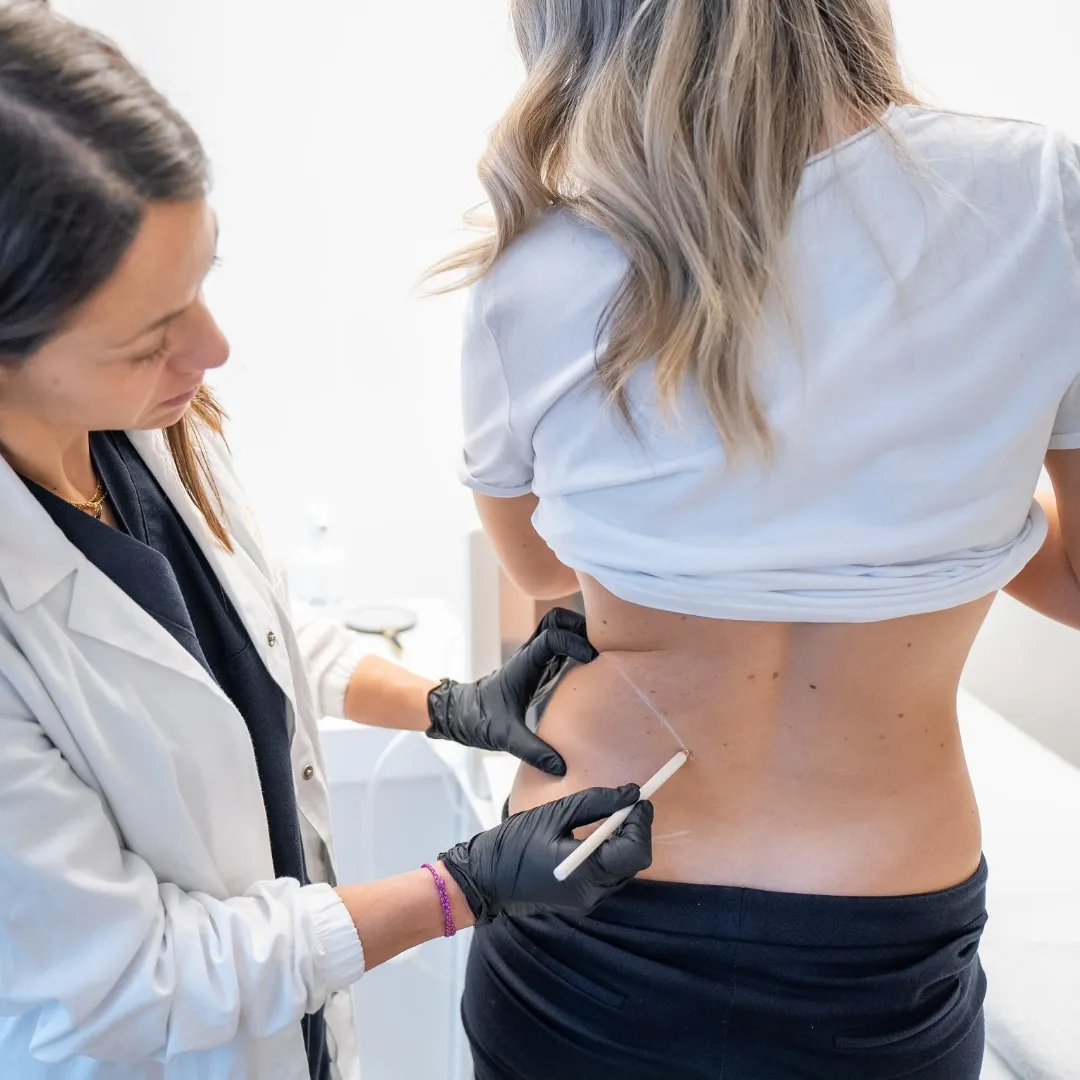
The longest part of the consultation isn’t the examination, it’s your story: when it started, how it changed during hormonal phases, what happened with diets, who in your family has something similar. Then comes the clinical examination, which looks for exactly the signs described above, and, when needed, a venous or lymphatic assessment.
By the end of the consultation the aim is to have three answers: whether it’s lipoedema, at what stage, and which options are realistic in your case. The care pathway (conservative therapy, and surgery where indicated) is described in detail in the lipoedema treatment page.
What treatment doesn’t do
This is the part that needs to be said most clearly, because it’s where the wrong expectations are built.
- It doesn’t cure lipoedema. It’s a chronic condition: it’s managed, not eliminated. Anyone promising a permanent cure isn’t describing this disease.
- It isn’t a weight-loss programme. The goal is to reduce pain, heaviness and progression, not the number on the scales.
- Surgery doesn’t close the chapter. Even after lipoedema-specific liposuction, compression and lifestyle remain part of management, because the underlying condition is still there.
- It isn’t a cosmetic procedure. Better proportion of the limbs, when it comes, is a consequence, not the main goal.
How to spot a poor proposal
Women who have lived with lipoedema for years are often exhausted and willing to try anything. That’s exactly when you’re most exposed to proposals that won’t help.
The promise of a cure. Lipoedema doesn’t go away. A proposal that talks about a permanent solution is selling something that doesn’t exist.
Surgery offered without diagnosis and staging. Before talking about an operation, it has to be established that it’s lipoedema, at what stage, and whether there’s a lymphatic or venous component. Liposuction offered at first glance skips every one of these steps.
No conservative therapy. Compression and the rest of conservative management are the foundation of the pathway, at every stage. If nobody mentions them, the pathway is incomplete.
Packages of “draining” treatments sold as the solution. Some techniques can play a supporting role within a pathway set up by a doctor; sold on their own and in bundles, as the answer to lipoedema, they don’t.
Still “eat less and move more”. Diet and exercise matter, but as part of management, not as the explanation of the problem. If the answer you get is the same one you’ve heard for years, lipoedema probably wasn’t even considered.
In conclusion
Lipoedema is a real, recognised condition that doesn’t depend on your willpower. Recognising it doesn’t make it disappear, but it changes everything else: you stop chasing diets that can’t work on your limbs, and you start a pathway designed for what you actually have.
If you recognise yourself in this description and nobody has yet put a name to what you’re living with, a dedicated assessment will help establish whether it’s lipoedema and what can realistically be done. And if it isn’t, you’ll still have a clear answer, which is already a starting point.
Related Treatment
Lipoedema Milan — Diagnosis and Treatment with Dr. Alice Miegge
Lipoedema is a chronic disorder of adipose tissue, almost exclusive to women, characterised by a symmetrical and painful accumulation of fat in the limbs that doesn't respond to diet and exercise. It's often mistaken for obesity or fluid retention and goes undiagnosed for years. The pathway always begins with differential diagnosis and staging, before any treatment is proposed.

Who wrote this article
Dr. Alice Miegge
Surgeon specialised in General Surgery, with a Master's Degree in Aesthetic Medicine and Laser Therapy (University of Pavia). Fellowship at Imperial College NHS Trust, London. Author of 15+ international scientific publications.